Forklift Licence Classes Explained: LF, LO and What Your Site Needs

Published 5 September 2026 by Bluestone Labour Group.

Two High Risk Work licence classes cover forklifts in Victoria. LF covers a forklift truck. LO covers an order picking forklift truck. They are separate licences, holding one does not authorise the other, and confusing the two is the most common licensing failure we see on a warehouse floor.

The split is not administrative tidiness. It exists because the two machines put the operator in a different place. On an LF machine the operator stays on the ground while the load goes up. On an LO machine the operator goes up with the load, which changes the fall risk and the training behind the licence. This guide sets out which class covers which machine, what needs no licence at all, and what you are expected to check as a host employer before anyone starts a shift.

Which class covers which machine

The distinction that decides whether an operator can legally touch the machine.

LF, forklift truck

A powered industrial truck with a mast and an elevating load carriage, where the operator stays at ground level while the load goes up. The standard counterbalance forklift sits here, and so does a reach truck, because the operator does not rise with the load.

LO, order picking forklift truck

A powered industrial truck where the operator's controls sit on the load carriage and rise with it. Order pickers and stock pickers sit here. An LF licence does not authorise this machine and an LF holder cannot legally operate one.

Sites that run both

Plenty of distribution floors run counterbalance machines and order pickers side by side. Where yours does, the operator needs both classes printed on the card, not one of them and an assurance about the other.

What the card shows

A High Risk Work licence is issued for five years and carries a photograph, the licence number, the classes held and an expiry date. It is issued in Victoria by WorkSafe and is recognised in the other states.
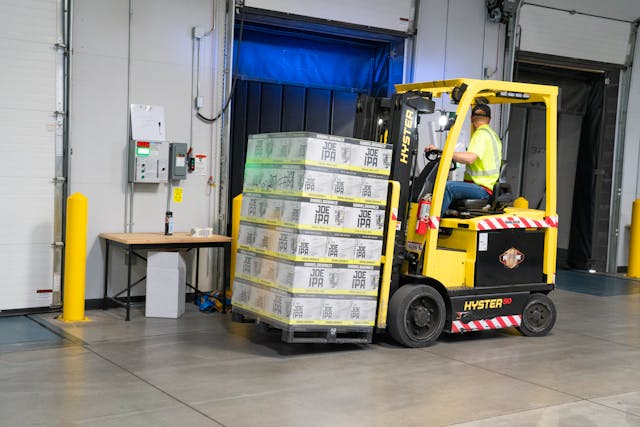
Forklift operator working in a Melbourne distribution warehouse

Machines that need no High Risk Work Licence

No licence is not the same as no obligation.

Manual pallet jack
Powered pallet truck
Pedestrian walkie stacker

None of these three require a High Risk Work licence. All of them still require training, instruction and supervision under general health and safety duties, and a powered pallet truck in a busy aisle injures people every year. Treat the absence of a licence class as a reason to check the training records, not as a reason to skip the conversation.

What a host employer should check

  • The card itself, with the name and the photograph matching the person standing in front of you. A picture of a card on a phone is not a check.
  • The class against the machine. LF, LO, or both, matched to what is actually on your floor rather than to what the request said.
  • The expiry date. High Risk Work licences run for five years and an expired one authorises nothing.
  • Recent experience on that type of machine, not simply a licence obtained at some point in the past.
  • Verification of competency on your own machine, its guarding, its attachments and its isolation procedure. That one has to happen on your site.

Who is responsible for what

The provider verifies the licence before the worker is offered, sights the physical card, checks the class against the machines you have described, and confirms the worker has actually run that type of machine. That is our job and you should expect evidence of it rather than an assurance.

The host controls the site, so the site induction, the traffic management plan separating machines from pedestrians, the racking and aisle conditions, and verification of competency on your specific plant sit with you. None of that can be handed to a labour hire provider, because none of it happens where we are.

Under the Occupational Health and Safety Act 2004 (Vic) both parties hold a duty to the worker, and neither can contract out of it. A licensed operator supplied by a licensed provider does not discharge your obligations as the host, and a thorough site induction does not discharge ours.

Bluestone Labour Group holds Victorian Labour Hire Licence VICLHL11535. We verify the licence class against the machines on your floor before an operator is offered to you. See forklift operator hire for how that works in practice.

Frequently asked questions

No. LF and LO are separate High Risk Work licence classes and neither authorises the other. An order picker raises the operator with the load, which is why it carries its own class. If the worker only holds LF, they can run your counterbalance and reach trucks and nothing else.

No, a reach truck falls under LF. The operator stays at ground level while the mast extends, so it sits in the same class as a counterbalance forklift. Reach work still needs experience, and a licence on its own does not tell you whether someone has worked in narrow aisle before.

No. Manual pallet jacks, powered pallet trucks and pedestrian operated walkie stackers do not require a High Risk Work licence. They do require training, instruction and supervision under general health and safety duties, so no licence is not the same as no obligation.

Five years from issue, after which it has to be renewed. The expiry is printed on the card. An expired licence authorises nothing, and it is worth checking the date rather than the class alone, because a card that looks right can still be out of date.

Where this applies

Need licensed forklift operators?

Tell us which machines are on the floor and we will match the licence class to them. Looking for work instead? Register as a worker.

Bluestone assistant

Ask us anything about our services.

Call 0410 672 349 Request workers